Summary
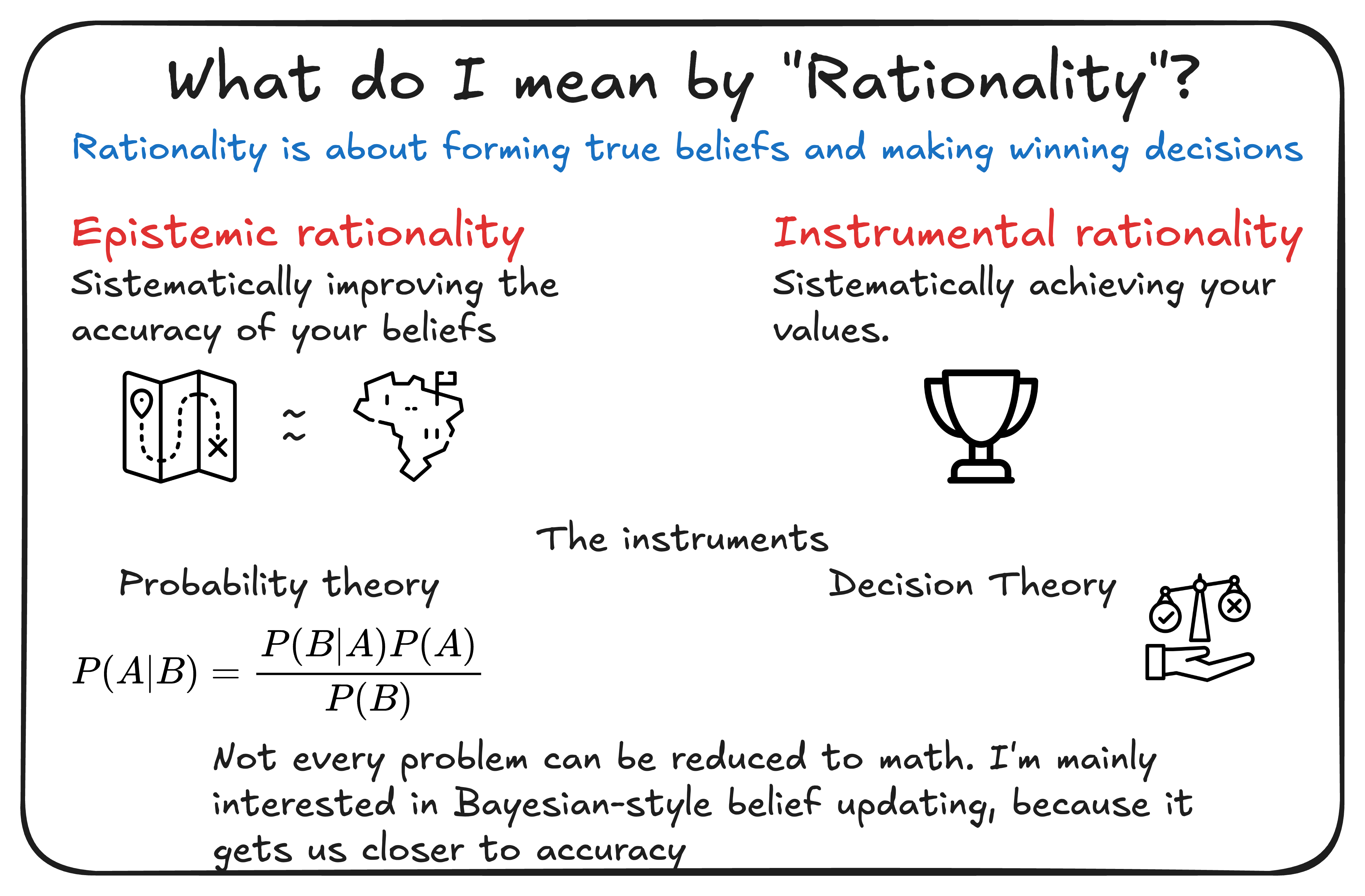
two sub-terms:
-
Epistemic rationality: systematically improving the accuracy of your beliefs
-
Instrumental rationality: systematically achieving your values.
-
Epistemic rationality is about building accurate (mental) maps, in order to improve the correspondence between your beliefs (the map) and the reality (the territory). The example he provides is about locating in your mind the position of the objects in your room: if your model says that there is a bookcase where no bookcase exists, your model might be unsynchronized with the reality. It can also be about uncertain facts or indirect evidence (e.g. you can assert/believe lost the Leipzig battle, even if you’ve never met him).
-
Instrumental rationality is about steering reality, choosing actions that lead to outcomes ranked higher in your preferences. It doesn’t mean being selfish or put other people down: your preferences can also be about sharing/caring.
In short,
Rationality is about forming true beliefs and making winning decisions.
I think that accurate beliefs can give you a considerable advantage when taking decisions, because your choices are mostly based on true facts and their outcomes might have less variance and can be kept under control.
Rationality makes use of two important instruments, probability theory and decision theory.
- Probability theory is the set of laws underlying ration belief;
- Decision theory is the set of laws underlying rational action.
Beliefs and actions that are rational in this mathematically well-defined sense are called Bayesian.
The problem is that these instruments are not sufficient in practice, for some reasons:
- Bayesian formalism is intractable in most of real-world problems: it’s hard for instance to apply Bayes’ theorem to decide who is right in a fight between siblings. Language, most of the time, does not follow logical axioms only, it’s richer and more complex. For sure knowing some basic logic can help you understand, for instance, when a speech is misleading or logically wrong.
- Sometimes the meaning of the math itself is called into question: there are some problems. if I understood correctly, where math mislead you, see for instance anthropic problems or Newcomblike problems.
- Rationality is not only about reasoning in words: sometimes it’s just about intuitions, it can involve all the senses, and emotions play an important role. For instance, a nice question where we don’t want to involve the math at all is “How do you feel once you have reached the truth”?
Because of their limitations, he refuses a precise definition of the word rationality, what he’s interested the most is about following a Bayesian-style belief-updating approach: I read it as “know the tools, the math, and use them to your advantage in order to get closer to accuracy, but also don’t be too much strict with these rules, always keep a critical eye towards your beliefs and your instruments, updating them frequently whenever you reach a point where you see that your ideas no longer apply against reality”.
Credits, references and further reading
- Eliezer Yudkowsky Rationality: From AI to Zombies, 2015 (9781939311153)
- map icon made by Smashicons from flaticon.com
- Brazil icon made by mangsaabguru from flaticon.com
- Trophy icon made by Freepik from flaticon.com
- Origami icon made by Nhor Phai from flaticon.com
- Decision icon made by iconixar from flaticon.com